Apple serial number decoder: a worked Mac serial from start to finish
A character-by-character walkthrough of the 12-character Mac serial C02XG...JG5J (factory, year, half-year, week, configuration) using the same reverse-engineered tables every legacy Apple serial number decoder relies on.

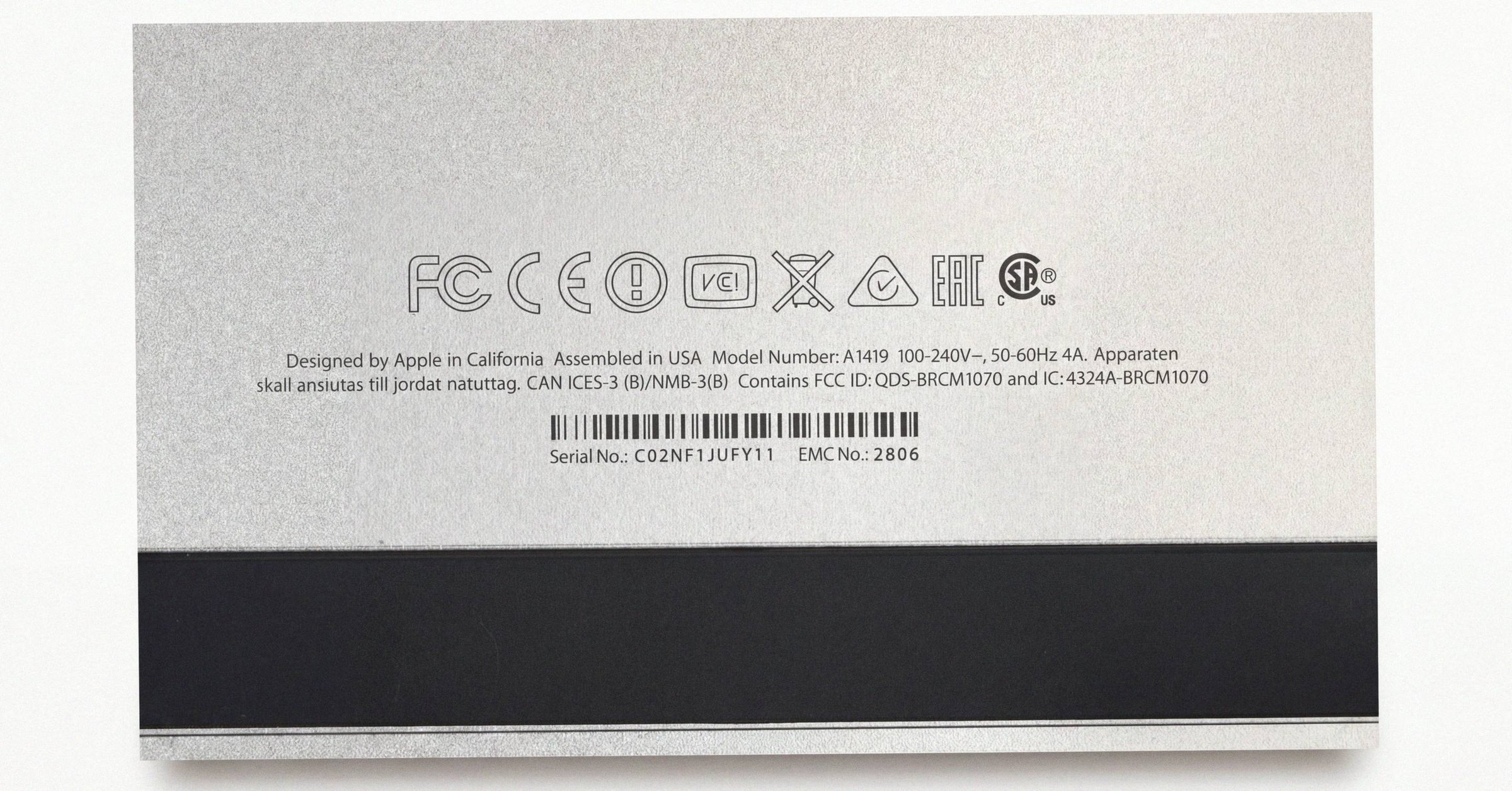
Apple serial number decoder: a worked Mac serial from start to finish#
C02XG...JG5J decodes to a 15-inch MacBook Pro assembled at Quanta's China factory in week 39 of 2018, late September. Every character carries information; this post walks through the full decode position by position using the community-derived tables every working Apple serial number decoder relies on. For the broader identifier reference (serial vs Model Identifier vs A-number vs part number), see the Mac identifier complete guide.
The procedure applies only to the 12-character serial format Apple used on Macs from 2010 through early 2021. Randomized 10-character serials (shipped from late 2021 onward) carry no decodable structure. The legacy format still covers the majority of secondary-market Macs in circulation today.
The shape of the serial#
The 12-character format is PPPYWSSSCCCC:
| Position | Meaning |
|---|---|
| 1-3 | Manufacturing location / factory code |
| 4 | Year + half-year letter |
| 5 | Week within the half-year |
| 6-8 | Random unique unit identifier |
| 9-12 | Configuration code |
Positions 1-3: C02, Quanta Computer (Tech Com), China#
The first three characters encode the manufacturing location. C02 resolves to Quanta Computer's Tech Com subsidiary in China. Positions 1-2 identify the facility; position 3 narrows to the specific plant or assembly line within that facility, per the MacRumors WikiPost on decoding Apple serials.
Apple has never officially published the factory-code table. The mapping is community-derived from extensive reverse engineering: Beetstech, the MacRumors WikiPost, and acidanthera's macserial source. The complete plant breakdown lives in Mac serial factory codes: what the first three characters reveal. A representative selection of codes that appear on legacy Macs:
| Code | Factory |
|---|---|
C02 | Tech Com (Quanta subsidiary), China |
C0 | Tech Com (Quanta subsidiary), China |
C3 | Foxconn, Shenzhen, China |
C7 | Pegatron, Shanghai, China |
F, F1, F2, F7, FK | Foxconn, China (various sites) |
DN | Foxconn, Chengdu, China |
EE, QT, QV, UV | Quanta, Taiwan |
VM | Foxconn, Pardubice, Czech Republic |
CK | Cork, Ireland (historic BTO facility) |
Knowing the factory is rarely actionable for ordinary buyers, but it matters for diagnosing batch-specific defects: a thermal or solder-joint failure clustering around a single factory code points to an assembly-line issue rather than a global architectural one.
Position 4: X, second half of 2018#
The fourth character encodes both the year and the half-year in a single letter. X = 2018 H2. The full first-half / second-half letter table and the decade-ambiguity rules are in the position-4 year-letter reference. The second-half-letter mapping for the 2010-2021 era:
| Letter | Half-year |
|---|---|
D | 2010 H2 (or 2020 H2) |
G | 2011 H2 (or 2021 H2) |
J | 2012 H2 |
L | 2013 H2 |
N | 2014 H2 |
Q | 2015 H2 |
S | 2016 H2 |
V | 2017 H2 |
X | 2018 H2 |
Z | 2019 H2 |
The cycle repeats every decade, so X could in principle mean 2008 H2 or 2028 H2. But Apple did not use this 12-character format in 2008 (pre-2010 serials are 11 characters) and retired it in early 2021, so context resolves the ambiguity.
Omitted letters (A, B, E, I, O, U) skip vowels for legibility and to prevent the alphabet from generating profanity. O and I are specifically excluded by Apple's general serial-number rule to prevent confusion with 0 and 1, per Apple Support 102858.
Position 5: G, week 13 of the half-year (so week 39 of 2018)#
The fifth character is the production week, but only within the half-year that position 4 specifies. For the full week-alphabet rules (including the Y = week 27 edge case in 53-week ISO years), see how to read the production-week character. The week alphabet uses digits 1-9 for weeks 1-9 and letters for weeks 10-26:
| Char | Week | Char | Week | Char | Week |
|---|---|---|---|---|---|
1 | 1 | 9 | 9 | N | 18 |
2 | 2 | C | 10 | P | 19 |
3 | 3 | D | 11 | Q | 20 |
4 | 4 | F | 12 | R | 21 |
5 | 5 | G | 13 | T | 22 |
6 | 6 | H | 14 | V | 23 |
7 | 7 | J | 15 | W | 24 |
8 | 8 | K | 16 | X | 25 |
L | 17 | Y | 26 (or 27) |
G is week 13. But this is only the week within the half-year, not within the calendar year. The +26 rule applies whenever position 4 is a second-half letter:
- Position 4 is a first-half letter (
C,F,H,K,M,P,R,T,W,Y): position-5 week is the calendar week directly. - Position 4 is a second-half letter (
D,G,J,L,N,Q,S,V,X,Z): add 26 to the position-5 week.
X is a second-half letter, so 13 + 26 = week 39 of 2018 (late September; ISO week 39 of 2018 runs Mon Sept 24 to Sun Sept 30).
The +26 adjustment catches casual users out. Many third-party decoders silently report "week 13" without indicating which calendar week that maps to, leaving users to assume they have an early-spring Mac when they actually have a late-September one.
Positions 6-8: random unit identifier#
Three characters whose only purpose is collision avoidance, making sure two identical units off the same line in the same week receive distinct serials. No decodable meaning. Everything before position 6 narrows you to a batch (factory, week); 6-8 disambiguate within that batch; 9-12 push back out to the SKU level.
Positions 9-12: JG5J, MacBook Pro (15-inch, 2018)#
The last four characters are the configuration code: an index into Apple's SKU database, encoding model, color, storage tier, and other configuration attributes. Two different configuration codes can map to the same marketing model if only storage or color differs.
You can decode JG5J three ways:
-
Apple's own XML endpoint. Append the configuration code to
https://support-sp.apple.com/sp/product?cc=. This is Apple's own attestation and is more reliable than third-party scraped databases:<?xml version="1.0" encoding="utf-8"?> <root> <name>CPU Name</name> <configCode>MacBook Pro (15-inch, 2018)</configCode> <locale>en_US</locale> </root> -
EveryMac's Ultimate Mac Lookup. Queries an aggregated catalog and returns marketing model, CPU, GPU, RAM, SSD, ports, original price, EMC, A-number, Model Identifier, and order number.
-
chipmunk.nl (chipmunk.nl/klantenservice/applemodel.html). Quick legacy-serial decoder, limited daily quota.
All three resolve JG5J to MacBook Pro (15-inch, 2018), a specific RAM/SSD/color SKU. The Model Identifier is MacBookPro15,1 or MacBookPro15,3 depending on graphics configuration.
Putting it all together#
| Chars | Meaning |
|---|---|
C02 | Quanta Computer (Tech Com subsidiary), China |
X | 2nd half of 2018 |
G | Week 13 of that half-year, so 13 + 26 = week 39 of 2018 (late September) |
| (random) | Unique unit identifier |
JG5J | Config code, MacBook Pro (15-inch, 2018), specific RAM/SSD/color SKU |
C02XG...JG5J is a 15-inch MacBook Pro, assembled at Quanta's China factory in late September 2018. A Check Coverage lookup confirms the model and surfaces the AppleCare expiration calculable from the registration date. EveryMac, chipmunk.nl, and Beetstech return the same identification purely from the serial, no online lookup against Apple needed.
When this method stops working#
The 12-character format went out of use starting early 2021. Per internal AppleCare communications obtained by MacRumors, corroborated by AppleInsider and 9to5Mac, Apple switched to randomized alphanumeric serials 8-14 characters long, typically 10. The new format "will no longer include manufacturing information or a configuration code."
Rollout on Macs was SKU by SKU: the 14-inch and 16-inch MacBook Pro with M1 Pro/Max (October 2021) was among the first; the 24-inch iMac with M1 (2021) still used the legacy format despite launching that year, per EveryMac; all M2/M3/M4-generation Macs ship with randomized serials.
A randomized serial like H7KX4N2P9Q has no decodable structure. Check Coverage still returns the marketing model (Apple's internal database links every randomized serial to a SKU at the factory) but no third-party site can decode it standalone. They query a backend database keyed by serial, or fall back to other identifiers (order number, Model Identifier, A-number + EMC). The randomized-era serial cross-check workflow covers what still works on these units.
What this means if you're decoding a Mac#
For a 12-character serial in the 2010-2020 range, the procedure above gives you factory, half-year, production week, and (via the configuration code) the marketing model, purely from the serial, no live Apple lookup needed. Enough to verify a listing's claimed model and spot inconsistencies between a seller's claimed year and the actual manufacture date.
For a 10-character serial, treat it as a dumb token. Cross-check the order number (MNEH3LL/A style), the Model Identifier from About This Mac, and the A-number plus EMC etched on the chassis. None of those changed in 2021. Only the serial did. And if all you need is the model behind a randomized serial, the Macfax serial lookup resolves it against Apple's own device database, free and without an account. checkcoverage.apple.com works the same regardless of serial format.
Have a serial in front of you? The Macfax lookup reads the model, year and configuration, and shows what Apple's own tools leave out.
Related posts
Pre-2010 Mac serial number decoder: reading the 11-character format
The 11-character pre-2010 Mac serial decoder reads factory (2 chars), year digit (1 char), production week (2 chars), unique ID (3 chars), configuration code (3 chars). The single-digit year is the gotcha; a `3` means 2003, not 2013.
Mac manufacture date by serial number: decoding the year-and-half-year letter
To get the Mac manufacture date from a 12-character serial number, decode the fourth character. It is one letter encoding both year and half-year. X is 2018 H2, F is 2011 H1 or 2021 H1, and the decade ambiguity is resolved by the product itself.
Apple serial number check: the complete guide to looking up a Mac
Apple serial number check is the canonical way to identify a Mac by serial. This is the complete reference for what a Mac serial tells you, where to find one on every Mac family, and how to look up a device across three eras of Apple hardware.
Written by
Marcus WilliamsMarcus Williams covers Mac hardware and repair for Macfax. He spent six years on the bench at an Apple Authorized Service Provider in the Pacific Northwest before going independent, most of that time on logic-board repair, display assembly swaps, and the failure patterns Apple's diagnostics don't surface. He writes about what's inside a Mac, what breaks first, and what a serial number can and can't tell you about a unit's history.
More posts by Marcus →