Working with post-2021 Mac serial numbers: what you can and can't decode
Post-2021 Mac serial numbers are randomized 10-character strings that encode nothing. No factory, week, or configuration code. Treat the serial as a dumb token only Apple's database resolves, and lean on the order number, Model Identifier, and A-number plus EMC for offline verification.

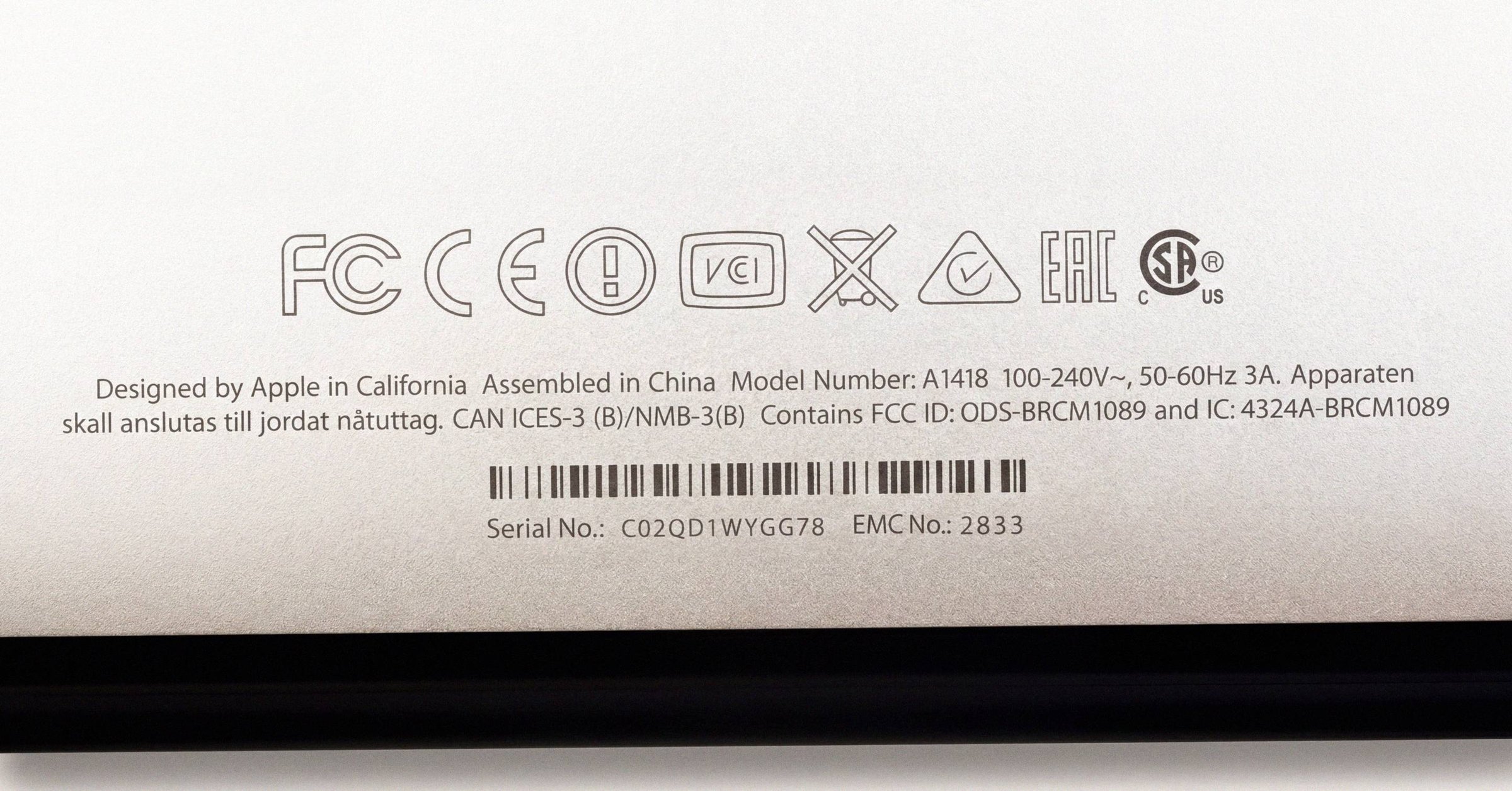
On a Mac released since late 2021, the serial number is a randomized 10-character string that encodes nothing. No factory, no manufacturing week, no configuration code, just an identifier Apple's central database can resolve to a SKU. Every offline decoder that worked on the previous 12-character format stops being useful, and verifying configuration offline now means leaning on the order number, the Model Identifier, and the A-number plus EMC instead. The longer story on why Apple replaced the legacy decodable serial format with randomized strings covers the anti-counterfeiting motivation behind the switch.
This post is the practical handbook for that world: what the serial does and doesn't tell you, which tools still work, and where the closest available substitutes for manufacture-date information live. For the full identifier hierarchy across every Mac era, see the cluster reference on looking up a Mac by serial. And if all you need is the model behind a randomized serial, the Macfax serial lookup resolves it against Apple's own device database, free and without an account.
What "post-2021" actually covers#
Apple's serial format changed in March 2021 per an internal AppleCare memo first reported by MacRumors and corroborated by AppleInsider and 9to5Mac the same day. The new format is randomized alphanumeric, 8 to 14 characters long, with 10 characters as the rolled-out implementation. Per the memo, it "will no longer include manufacturing information or a configuration code."
Rollout on Macs was SKU by SKU rather than a single flag day:
- The 14-inch and 16-inch MacBook Pro with M1 Pro / M1 Max (October 2021) was among the first Macs in the new format.
- The 24-inch iMac with M1 (2021) kept the legacy 12-character format despite launching that year, per EveryMac.
- Every M2-, M3-, and M4-generation Mac ships with a randomized serial.
A practical consequence: "2021 Mac" doesn't automatically mean "randomized." If the serial is 12 characters and the year/week encoding parses against the third-party tables, you have a legacy-format Mac. If it's 10 characters and structurally meaningless, you have a randomized one.
What still works#
The randomized format is unique-identifier-only. It is still a real serial. Apple's database links it to a SKU, manufacturing date, destination region, and (after activation) a registered owner. The lookups that hit Apple's backend still work.
checkcoverage.apple.com is the canonical lookup. Enter the serial, complete the captcha, and Apple returns the marketing model name, estimated purchase date, limited warranty status, and AppleCare/AppleCare+ status. Format doesn't matter. Check Coverage doesn't parse, it queries. Every field Coverage Check returns on a post-2021 serial walks the result states a randomized serial can produce.
Apple's "Identify your Mac" support articles (MacBook Pro 108052, MacBook Air 102869, iMac 108054, Mac mini 102852, Mac Studio 102231, Mac Pro 102887) accept Model Identifiers, A-numbers, and part numbers, none of which changed in the 2021 transition.
Apple Support and AASPs can resolve any serial via the internal Global Service Exchange (GSX) portal. That access is gated to authorized providers; no public third-party "GSX lookup" site is genuinely connected to that data.
What no longer works#
Parsing the serial itself. None of the structural decoders that defined the legacy era have anything to chew on.
- EveryMac's classic per-character decoder.
- chipmunk.nl, which explicitly limits itself to legacy serials.
- Apple's own configuration-code XML endpoint,
https://support-sp.apple.com/sp/product?cc=XXXX. Randomized serials have no configuration code to feed it. - acidanthera's
macserialparsing logic. - The MacRumors WikiPost decoder tables.
Third-party services that still return useful results on randomized serials have changed their architecture. They now fall into three camps:
- Backend-database lookups. EveryMac's Ultimate Mac Lookup maintains a database of issued serials and matches by query rather than by parsing. It works on randomized serials when the database has the relevant SKU populated.
- Identifier fallback. Services like Beetstech's Sentient Search accept order numbers, Model Identifiers, A-numbers, and EMC numbers, and resolve the configuration from those rather than the serial.
- Refusal. Mactracker, per its own FAQ, supports 11- and 12-digit serials through the 24-inch iMac M1 (2021); for newer randomized serials it directs users back to Apple.
The offline-verification fallback chain#
When you have a recent Mac in front of you and need to verify configuration without contacting Apple, the serial is the wrong tool. The rest of Apple's identifier set is mostly unchanged and still carries usable information.
| Identifier | Example | Where it lives | What it tells you |
|---|---|---|---|
| Order number | MNEH3LL/A | Box label, invoice, receipt | Chassis + chip + RAM + storage + color + region |
| Model Identifier | Mac14,7 | system_profiler SPHardwareDataType | One hardware platform / one SoC variant |
| A-number | A2338 | Etched on chassis | One chassis (may span SoCs) |
| EMC number | EMC 3601 | Etched on chassis | One logic-board electrical revision |
The order number is by far the most informative. It decomposes as [prefix][config code][region]/A. For example, MNEH3LL/A is M (brand-new retail) + NEH3 (the configuration code for MacBook Pro 13-inch M2 2022, Space Gray, 8 GB / 256 GB) + LL (United States) + the universal /A suffix. The four-character config code points into Apple's SKU table the same way the legacy serial's trailing four characters used to. Drop the order number into EveryMac or Beetstech and you get the full configuration. What every field in a Mac order number actually encodes walks the MNEH3LL/A structure piece by piece.
For custom-configured (CTO/BTO) Macs, the picture is even better. CTO units often carry "Z-identifier" part numbers (e.g., Z18L000SW) that encode the chosen processor, RAM, storage, graphics configuration, and sometimes the bundled power adapter directly. On a post-2021 CTO Mac, the Z-number is the most spec-revealing identifier on the device.
The Model Identifier is the second-most-useful offline check. Run system_profiler SPHardwareDataType and the Model Identifier field reports something like Mac14,7, a single hardware platform, one SoC variant. From M2 onward Apple consolidated the family-prefix naming (so MacBookPro / iMac / Macmini became simply Mac with major/minor versioning), but the identifier still pins the platform precisely. Look it up in Apple's "Identify your…" page or in community catalogs like AppleDB or The Apple Wiki and you have the marketing model and chip.
A-numbers and EMC numbers retain the same caveats they always have. An A-number is the chassis identifier and Apple regularly reuses chassis across SoCs (the A2338 13-inch MacBook Pro shipped with M1 in 2020 and M2 in 2022 in the same chassis), so an A-number alone is rarely enough. See the catalog of consequential A-number reuses across recent Macs for the full list. The EMC number is the logic-board revision and is what cleanly distinguishes generations within a reused chassis. But Apple silicon Macs have de-emphasized EMC numbers in favor of Model Identifiers, and some recent SKUs don't print one prominently. For Intel-era hardware still in the secondary market, A-number + EMC remains the cleanest two-field disambiguator.
Manufacture date: there is no substitute#
The legacy 12-character format encoded the manufacturing factory and week directly into the serial. Position 4 was the year and half-year letter, position 5 the week within that half-year, and the first three characters identified the plant. On a Mac in that format, the serial alone gave you the assembly week and factory line, no Apple lookup required.
On a randomized serial, there is no equivalent. The closest available proxy is the Boot ROM Version field in About This Mac, System Information, Hardware. The boot ROM is a firmware blob Apple ships at a known build date, and the version string roughly bounds when the firmware on the device was built. It is useful for distinguishing "definitely later than" boundaries (a Mac with a recent boot ROM version cannot be from before that version's release), but it is firmware build date, not assembly date. A Mac assembled in June can ship with a boot ROM built in January.
For genuine purchase-date or assembly-date certainty:
- The Apple Account device list at account.apple.com, Devices, shows the serial alongside marketing model name, model number, and warranty info for every device tied to the Apple ID.
- The original receipt from the retailer.
- An Apple Support inquiry with the serial. They can pull GSX data including the original sale date and warranty start.
Check Coverage's "Estimated Purchase Date" is the registration/activation date, not the retail-purchase date. For Macs that sat in retail channel before sale, activation can be days or weeks after the customer's actual purchase. Apple Support can update the warranty start date with a dated receipt if accuracy matters.
"Invalid serial" causes shift on randomized format#
The 2021 transition was partly driven by anti-counterfeiting. Under the deterministic legacy scheme, counterfeiters could generate strings that matched the format even if they didn't correspond to any real device, and only a Check Coverage query would catch them. Under the randomized scheme, a randomly generated 10-character string has astronomically low odds of matching an issued serial. A "this serial number isn't valid" response on a post-2021 Mac, in rough frequency order:
- Typo or misread. The most common cause. Apple omits
OandIfrom serials per Apple Support 102858, so what looks like anOis a0and what looks like anIis a1(more on each invalid-serial cause and its fix). Strip any leadingSfrom a barcode scan. - Brand-new unit, not yet in the database. Activation populates the coverage database. Brand-new units sometimes need 24 to 48 hours before Check Coverage recognizes them.
- Counterfeit or cloned device. Rare on randomized serials but possible.
- Flagged status. Lost/stolen reports or revoked records after a fraudulent claim.
- Regional restriction. Try the country-specific Check Coverage URL, e.g.,
checkcoverage.apple.com/jp/ja/. - Post-repair database lag. Briefly after a logic-board swap and re-serialization.
What did not change#
The shift was specific to the serial number. Every other identifier Apple uses kept its existing structure:
- A-numbers are unchanged.
- Model Identifiers are unchanged in their role; Apple consolidated the family prefix in 2022 (a separate change), but the string still reports via
system_profiler SPHardwareDataTypeand still pins the platform. - Order / part numbers still decompose as
[prefix][config][region]/A. - EMC numbers are unchanged.
- IMEIs on cellular iPads are unchanged.
If you can read any of these off a device, the configuration lookup paths that worked in 2019 still work today.
What this means in practice#
For buyers, the practical workflow on a post-2021 Mac is: enter the serial into Check Coverage to confirm the model and warranty status; ask the seller for the order number (the MNEH3LL/A SKU code on the original box or invoice) to verify the exact chip / RAM / storage configuration; cross-check with the Model Identifier from About, System Information if the Mac is bootable. The serial alone, without one of these other identifiers, does not give you configuration certainty.
For sellers, listing the order number alongside the serial covers most buyer questions about configuration. On a CTO/BTO Mac, listing the Z-number is even more informative. The randomized serial carries no spec data, but the Z-number does.
For anyone identifying a Mac without contacting Apple: pivot away from the serial. The order number is the most informative offline identifier on a post-2021 Mac, the Model Identifier is the second-best, and the A-number plus EMC remains the cleanest disambiguator on older hardware. Apple's central database is now the only authoritative source for serial-to-SKU resolution, which is precisely the supply-chain and counterfeiting closure the 2021 change was designed to produce.
Have a serial in front of you? The Macfax lookup reads the model, year and configuration, and shows what Apple's own tools leave out.
Related posts
Mac manufacture date by serial number: decoding the year-and-half-year letter
To get the Mac manufacture date from a 12-character serial number, decode the fourth character. It is one letter encoding both year and half-year. X is 2018 H2, F is 2011 H1 or 2021 H1, and the decade ambiguity is resolved by the product itself.
Apple serial number decoder: a worked Mac serial from start to finish
A character-by-character walkthrough of the 12-character Mac serial C02XG...JG5J (factory, year, half-year, week, configuration) using the same reverse-engineered tables every legacy Apple serial number decoder relies on.
MacBook serial number lookup: the best third-party Mac decoders compared
MacBook serial number lookup tools that go beyond Apple's Check Coverage: a working survey of EveryMac, Chipmunk, Beetstech, Techable, AppleDB, The Apple Wiki, and Mactracker. What each returns, and which still work on post-2021 randomized serials.
Written by
Marcus WilliamsMarcus Williams covers Mac hardware and repair for Macfax. He spent six years on the bench at an Apple Authorized Service Provider in the Pacific Northwest before going independent, most of that time on logic-board repair, display assembly swaps, and the failure patterns Apple's diagnostics don't surface. He writes about what's inside a Mac, what breaks first, and what a serial number can and can't tell you about a unit's history.
More posts by Marcus →