Mac Studio case-swap fraud: weigh one and check Activation Lock before buying
Mac Studio case-swap fraud transplants lower-spec or Activation-Locked boards into clean-serial chassis. A digital postal scale catches the Max-in-Ultra swap because copper cooling cannot be faked; a buyer-side Activation Lock check catches the rest.

Mac Studio case-swap fraud: weigh one and check Activation Lock before buying#
The Mac Studio is the highest-value target for case-swap fraud in the used-Mac market because three structural facts line up: the outer chassis is dimensionally identical across all configurations in a generation, the price spread within one generation runs from $1,500 to $13,000+, and an intra-generation logic-board transplant boots and runs without complaint. Two defenses cover the patterns. A $15 digital postal scale exposes the lower-spec-board-in-higher-spec-shell variant in under a minute. A buyer-side Activation Lock check on a real network exposes the stolen-board-in-clean-shell variant. The first pattern hides in the listing photos; the second hides in the chain of custody. Both need to run.
What can be swapped, and what cannot#
Three facts shape what's swappable on a Mac Studio.
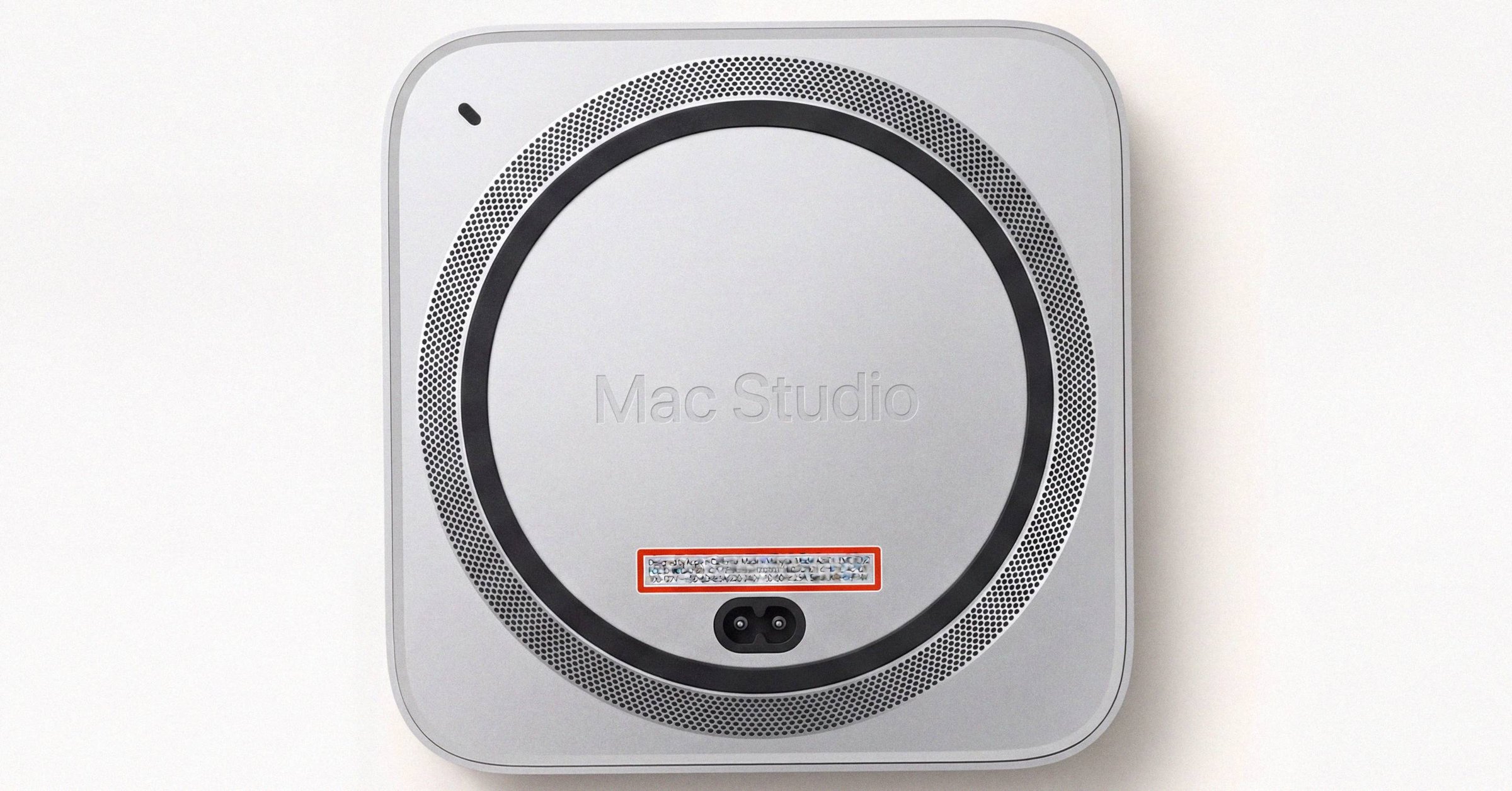
The outer chassis is the same. Every Mac Studio measures 7.7 x 7.7 x 3.7 inches in aluminum. From the outside, an M1 Max and an M1 Ultra are indistinguishable. The case-bottom laser-etched serial is independent of the logic-board serial reported by macOS, so a clean chassis can house a different board's identity entirely. Run both serials (the case-bottom one and the one in About This Mac) through the Macfax serial lookup: each returns a model and generation, and the two should tell the same story. Note what a serial cannot settle: Max vs Ultra within a generation, which is exactly what the weight check below is for.
The price spread is enormous. The lowest-spec Mac Studio in a given generation sells for $1,500-$2,000. The highest-spec configurations (M1 Ultra 64-core GPU / 128 GB / 8 TB; M2 Ultra 76-core GPU / 192 GB; M3 Ultra 80-core GPU / 512 GB / 16 TB) sell for $5,000-$13,000+. That is the dollar gap a scammer is harvesting.
Intra-generation swaps work. On Apple Silicon, the Secure Enclave and the SSD-SoC pairing block cross-generation transplants. An M2 board in an M1 chassis does not boot. Touch ID and SSD NAND are bound to the SoC cryptographically. But within a single generation, intra-model swaps run fine. An M1 Max logic board boots and runs in an M1 Ultra chassis and reports itself as a Max. Luke Miani demonstrated the underlying swap mechanics on a MacBook Pro, and Macworld covered the demonstration. The same boundaries apply to Mac Studio.
What cannot be swapped is the SSD modules themselves. On Apple Silicon Macs, the SSD modules are NAND-only and pair cryptographically with the SoC's storage controller. They are not self-contained SSDs and cannot be silently moved between machines without bricking. Useful to know which subassembly is fixed: the SSD modules are bound, the entire logic-board-plus-SoC-plus-NAND unit is the unit a scammer would transplant as a whole.
The three concrete patterns#
Three case-swap patterns recur on Mac Studio listings.
Higher-spec case, lower-spec board. The scammer acquires a damaged or stolen high-spec Mac Studio shell whose case sticker reads, say, "M1 Ultra, 128 GB, 4 TB," and transplants in a working but lower-spec board (M1 Max, 32 GB, 512 GB). Listing photographs of the case sticker, the retail box, and even a Check Coverage screenshot all corroborate the Ultra story. The buyer only discovers the discrepancy on first boot, when About This Mac reports the logic board's identity rather than the case sticker's.
Stolen or Activation-Locked board in a clean case. A scammer with a working but Activation-Locked logic board, often from a stolen Mac Studio, buys a damaged-case Mac Studio whose chassis serial is clean in Apple's systems and swaps the boards. Listing photos show the clean external serial. The buyer verifies it on checkcoverage.apple.com, sees a clean record, and pays. At first boot the unit is Activation-Locked to someone else's Apple ID, because Activation Lock follows the logic board, not the case. The Activation Lock check that catches this exact pattern is independent of the chassis-weight check and needs to run alongside it.
Donor-board partial swap. Less common but documented. A scammer swaps in a partially functional or DOA board into a known-working case after a return, returning the original board to a different seller in a different package. The pattern was first documented on MacBook Pro unibody returns.
All three patterns share one property: the case-bottom serial corroborates a story the board does not actually tell. The cross-check that catches them on macOS is straightforward, but only if the buyer also has a non-software check that cannot be spoofed at the sticker level.
The cooling-mass diagnostic#
The Mac Studio Ultra uses a substantially heavier copper thermal module to dissipate the Ultra SoC's larger thermal envelope. The Max uses a lighter aluminum heatsink. Copper is roughly three times denser than aluminum and substantially more thermally conductive, and the module is large. The result is a chassis weight difference of roughly two pounds, or one kilogram, between Max and Ultra configurations in the same generation. Mass is not spoofable at a sticker level. It does not depend on what About This Mac reports, what the case sticker says, or what shows up on Check Coverage.
Reference weights, from Apple's Mac Studio specs page and 512 Pixels' Mac Studio weight comparison:
| Generation | Configuration | Cooling | Reference weight |
|---|---|---|---|
| M1 Mac Studio | M1 Max | Aluminum heatsink | 5.9 lb / 2.7 kg |
| M1 Mac Studio | M1 Ultra | Copper thermal module | 7.9 lb / 3.6 kg |
| M3 / M4 Mac Studio | M4 Max | Aluminum heatsink | 6.1 lb / 2.74 kg |
| M3 / M4 Mac Studio | M3 Ultra | Copper thermal module | 8.0 lb / 3.64 kg |
Tom's Hardware covered Apple's adoption of the copper cooler when the M1 Ultra Studio shipped, including the engineering rationale.
A digital postal scale gives a definitive answer. An advertised M1 Ultra or M3 Ultra weighing close to the Max reference value almost certainly contains a transplanted Max logic board. No sticker manipulation, photo doctoring, or fake Check Coverage screenshot can hide a missing two pounds of copper.
Where the cross-checks fail without weight#
The standard pre-purchase serial checks catch some board swaps but not all of them. They miss case (b), the stolen-board-in-clean-case pattern, entirely.
On a powered-on Mac, About This Mac (Apple menu, then About This Mac, and on Ventura and later "More Info..." to System Report) reads the serial number from the logic board's NVRAM. From Terminal:
system_profiler SPHardwareDataType | grep "Serial Number"
returns the same value. A harder-to-spoof read uses IOKit:
ioreg -rd1 -c IOPlatformExpertDevice | awk -F'"' '/IOPlatformSerialNumber/ {print $4}'
The single most important verification is to read the logic-board-reported serial on a live boot and compare it to the laser-etched serial on the bottom of the case. On an untampered Mac, they are identical. After a board swap that hasn't been re-flashed (independent shops typically don't re-flash, and the Apple Service Toolkit / Blank Board Serializer needed to do so is released only to Apple Authorized Service Providers), the serials disagree.
Then both serials should resolve, on checkcoverage.apple.com, to the same model identifier and configuration. The model identifier maps to the chip variant, base RAM, and base storage the board shipped with (Mac13,1 = Mac Studio M1 Max; Mac13,2 = Mac Studio M1 Ultra; Mac14,13 = Mac Studio M2 Max; Mac14,14 = Mac Studio M2 Ultra; Mac15,14 = Mac Studio M3 Ultra), and Apple's Identify your Mac Studio page lists them all.
That works for pattern (a), the high-spec case with a low-spec board: About This Mac reports the donor Max board's serial, and checkcoverage decodes it to "Mac Studio M1 Max" instead of the advertised Ultra.
It does not work for pattern (b), the stolen Ultra-spec board in a clean Max case (or other variants where both pieces happen to resolve to a configuration consistent with the listing). The chassis serial is clean. About This Mac reports an Ultra. Check Coverage confirms Ultra. The serial cross-check passes. The defect is that Activation Lock is still active on the original owner's Apple ID, and the buyer only discovers this when they reach the activation server during Setup Assistant. In the worst version, the original owner has been phished out of their Apple ID through the Find My pipeline and the lock has already been cleared server-side, in which case the unit boots clean but remains stolen property.
A scale catches both patterns in 30 seconds. A Max board in an Ultra chassis weighs like a Max. An Ultra board in a Max chassis weighs like an Ultra in a Max body, which is itself anomalous because the Max chassis fans and internal mounting may not fit cleanly around the larger module. In either case, the mass tells the truth that the serial does not. The full landscape of MacBook scams when buying a Mac covers the patterns this scale doesn't catch.
The full pre-purchase protocol for a Mac Studio#
On any Mac Studio purchase above $2,000, run the full stack:
- Weigh the chassis on a digital postal scale. Compare against the reference table. An Ultra that weighs like a Max is a board swap. Bring the scale to the pickup or have the seller weigh it on a live, unedited video call.
- Inspect screws, structural boundaries, and the rubber base. Torn rubber feet, adhesive residue under the base, or misaligned seams suggest the case has been opened. A factory-sealed Mac Studio has uniform, intact rubber.
- Triple-match serial verification. The case-bottom serial, the About This Mac serial, and the IOKit serial must all be identical. All three should return the configuration the seller is advertising, on checkcoverage.apple.com and in the Macfax serial lookup. The Coverage Check 2026 guide that explains the "serial has been replaced" outcome on a swapped logic board covers the result state that catches this fraud before payment.
- Activation Lock status on a powered-on Mac. System Information, then Hardware Overview, must show "Activation Lock Status: Disabled." On Apple Silicon this is an explicit line in the report; the Activation Lock guide that explains why the lock follows the logic board, not the chassis covers the relevant binding for Mac Studio buyers.
- Force-erase test. Demand the seller run Erase All Content and Settings on video before payment. Boot must reach the Setup Assistant "Hello" screens without an Activation Lock prompt and without a Remote Management screen naming an organization.
The first item is the one this post is about. The other four are baseline used-Mac hygiene that any serious buyer should already be running. The scale is the addition that catches the specific failure mode that nothing else does.
What this means for a buyer#
A $15 postal scale catches a fraud pattern that costs $3,000 to $8,000 to walk into. The scammer's economic model depends on buyers verifying the case sticker and the listing photos and stopping there. The case-bottom serial is real. The Check Coverage screenshot is real. The retail box is real. The only thing that is wrong is the logic board, which is exactly the thing the case sticker doesn't see. It is also exactly the thing a hardware-bound report is built to see: a Macfax report the seller runs keys to the logic board rather than the case sticker, so a swapped board breaks the signature even when the case serial, the Check Coverage screenshot, and the retail box all check out.
Cross-generation board swaps fail to boot, so the newer the Mac Studio generation, the smaller the pool of donor boards a scammer can pull from. An M3 Ultra is safer against this specific scam than an M1 Ultra, because the secondary market for damaged M3 Max boards is still small. But anyone shopping the secondary market for an M1 or M2 Ultra Studio should treat weight as a required check, the same way they treat the serial cross-check. The reference numbers are public. The scale takes 30 seconds. The price spread the check protects is the largest in any single Mac model in current production.
Buying a Mac? Every listing on the Macfax shelf shows the exact configuration and an asking price in the open, with a signed report where the seller ran the checks.
Related posts
eBay empty-box scam on a MacBook sale: the four-defense stack for sellers
The eBay empty-box scam (item not as described) is the most prevalent fraud against high-value MacBook sales. A packing video, carrier-stamped weight, signature confirmation, and buyer vetting are the four defenses that hold up under appeal.
Facebook Marketplace seller scams on Mac sales: Zelle, fake payments, and cloned listings
Facebook Marketplace seller scams on Mac sales: the payment-side patterns that target Mac sellers, the signals that identify each, and the one procedural rule that defeats most of them.
The used Mac market in 2026: sizing, channels, and the AI demand layer
The used Mac market in 2026 has split into two economies: commodity M1/M2 MacBook Airs at $300-$600, and high-RAM Apple Silicon desktops trading like used enterprise GPUs. Sizing, channels, depreciation curves, and the AI demand layer through May.
Written by
Ben CarterBen Carter covers Mac marketplace fraud and the broader industry for Macfax. His reporting background is in investigative fintech, and at Macfax he focuses on counterfeit hardware, doctored listings, gray-market refurb operations, and the structural patterns in how secondhand-Mac fraud scales. He also writes the industry reports, covering pricing trends, marketplace share shifts, and the macro picture of where the used-Mac market is going.
More posts by Ben →