Used Intel Mac value in 2026: from the 2019 Mac Pro to the cheap laptops
Used Intel Mac value in 2026: most Intel Macs lose 25 to 35 percent per year versus 15 to 18 percent for Apple Silicon. A maxed 2019 Mac Pro is the durable exception. The residual is in PCIe and 1.5TB RAM, not the chip.

Used Intel Mac value in 2026: from the 2019 Mac Pro to the cheap laptops#
The 2019 Mac Pro maxed with 28-core Xeon W, 1.5TB of DDR4 ECC RAM, and an 8TB SSD sells for $3,500 to $6,500 used in May 2026. A base 8-core 2019 Mac Pro of the same vintage, with no expansion and no extra RAM, sells for $850 to $1,400. The chassis is identical. The chip family is identical. The five-times spread is the entire story of how Intel Macs hold value in 2026.
Most of the Intel fleet is now deep in terminal decline. Intel-era Macs depreciate at roughly 25 to 35 percent per year against 15 to 18 percent for Apple Silicon, and the gap has widened in 2026 because Apple Silicon residuals are running 3 to 6 percent higher in dollar terms year over year while Intel residuals continue their normal decay. The exceptions, where they exist, are workstations whose value never lived in the Intel chip in the first place. It lived in the platform around the chip. The companion overview of Apple Silicon resale levels covers the Apple Silicon side of this comparison.
The general Intel depreciation curve#
Apple Silicon Macs depreciate at roughly 15 to 18 percent per year in normal conditions. Intel-era Macs depreciate at 25 to 35 percent. The gap was already large before 2026; it has grown because the secondary market for Apple Silicon has had two distinct sources of unusual support this year (the DRAM shortage and AI-driven demand for high-memory Macs) while the Intel market has had none.
The mechanism is straightforward. The realistic buyer for a used Intel Mac in 2026 is shopping against current-generation entry-level Apple Silicon. A base M1 MacBook Air, even at five years old, still outperforms a 2019 16-inch MacBook Pro on most CPU and GPU benchmarks, runs cooler, gets dramatically better battery life, and is no longer cut off from current macOS. A used 2018 Intel Mac mini at $250 is competing against a used M1 Mac mini at $280, a Mac that is much faster and pulls less power.
Once Apple Silicon entered the secondary market in 2021, the price floor on Intel Macs started moving steadily downward, and the only Intel chassis whose residual held were the ones offering something Apple Silicon could not match.
The 2019 Mac Pro: where the residual actually lives#
The 2019 Mac Pro is the cleanest demonstration in the lineup of how Intel Mac value bifurcates. Same chassis, same chip family, two completely different residual trajectories.
| Configuration | Original price | Used (May 2026) | % retained |
|---|---|---|---|
| 8-core Xeon W base | $5,999 | $850 to $1,400 | ~14 to 23% |
| 28-core Xeon W / 1.5TB DDR4 ECC RAM / 8TB SSD | $25,000+ as configured | $3,500 to $6,500 | ~14 to 26% |
The base 8-core machine has lost roughly 80 percent of MSRP. That tracks the broad Intel decay curve, and it makes sense: an M2 Ultra Mac Studio at $4,000 new outperforms the base 8-core Xeon W on most CPU and GPU workloads, runs near silent, draws a fraction of the power, and fits in a much smaller footprint. There is no workload an 8-core 2019 Mac Pro does better than current-generation Apple Silicon at a similar price. The market has priced it accordingly.
The maxed configuration sells for several times more. The reason has nothing to do with the Xeon. It is the platform around the chip:
- Up to 1.5TB of expandable DDR4 ECC RAM in twelve DIMM slots. No Apple Silicon Mac currently exceeds 256GB of unified memory, and even the 512GB unified-memory M3 Ultra tier was discontinued in March 2026 (MacRumors, Tom's Hardware). For workloads that genuinely need a terabyte of ECC memory, the 2019 Mac Pro is still the only Mac that can do it. The 512GB M3 Ultra discontinuation premium covers the closest Apple Silicon parallel to the 2019 Mac Pro's discontinued-capability dynamic.
- Eight full-length PCIe expansion slots that accept FPGAs, capture cards, ProRes accelerators, MADI and Dante audio interfaces, specialty SDI capture hardware, and dedicated GPU silicon. The Mac Studio gives this audience nothing. The 2023 M2 Ultra Mac Pro retained the physical chassis but the slots no longer carry the general-purpose PCIe lanes that GPUs and many specialty cards require, so even Apple's own Apple Silicon Mac Pro did not solve the problem for the pro audio and pro video workflow audience.
That audience is small but persistent, and it is the reason the maxed 2019 Mac Pro is the highest-residual Intel Mac in the lineup by percentage. The residual is in the expansion capability, not the chip.
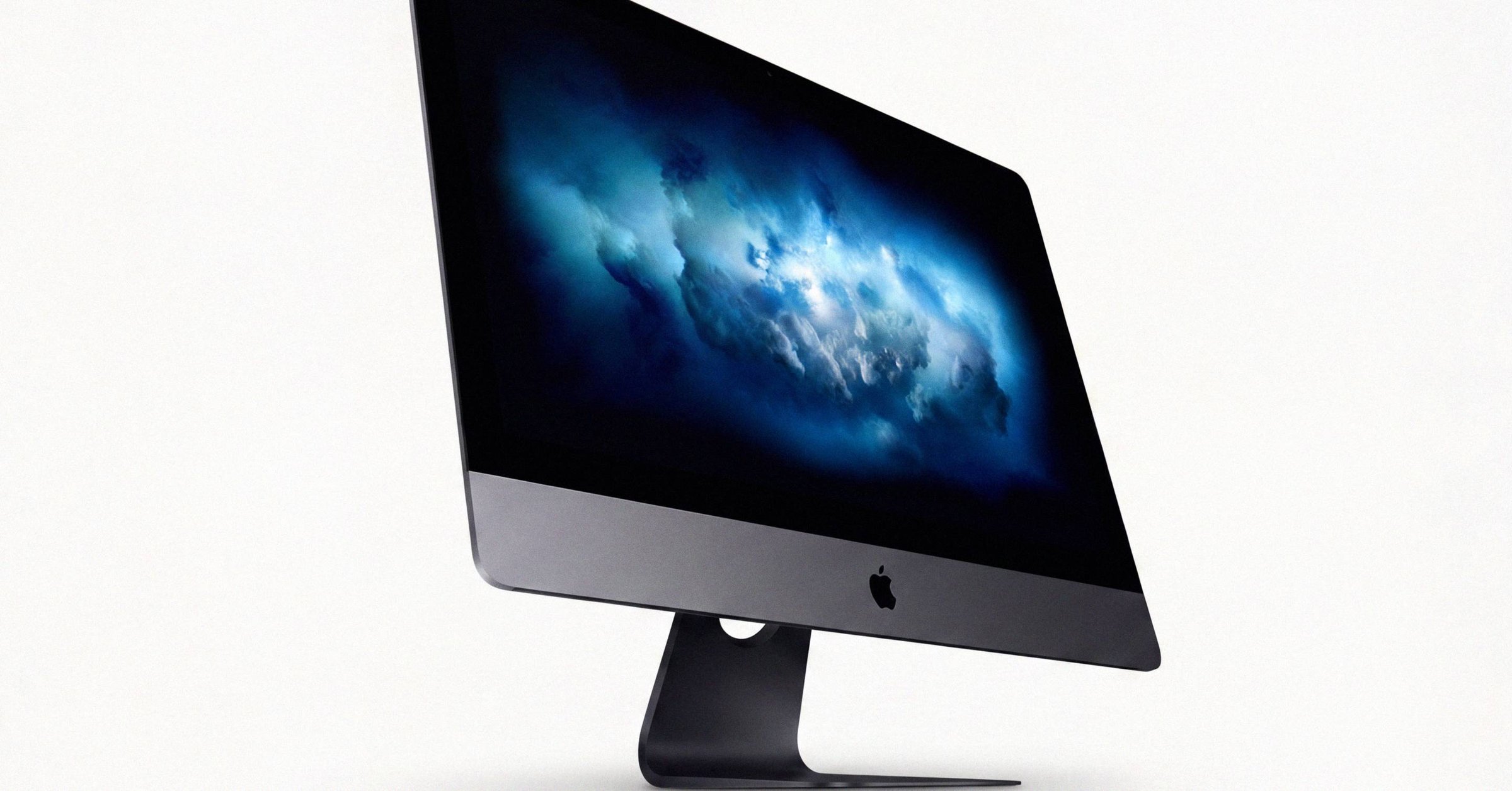
The 2017 iMac Pro: the integrated 5K exception#
The 2017 iMac Pro maxed out at 18-core Xeon W, 256GB ECC RAM, and a Radeon Pro Vega 64X GPU. Fully loaded configurations now sell for $1,500 to $2,800 used. Apple Trade In's cap on the same machine is $325. The peer-to-peer market pays roughly five to nine times what Apple offers, on a nine-year-old Intel workstation.
The premium is in a single attribute: an integrated 5K Retina display attached to a workstation-class CPU and discrete GPU. Apple Silicon has not replaced this combination. A current Mac Studio plus a Studio Display gets you to similar capability with a much faster chip, but the integrated form factor is gone. For a specific population of users (pro video editors and color graders working in tight studio setups, anyone wanting a single-cable workstation with no external GPU enclosure, anyone who values the 5K panel specifically), the iMac Pro is the only Mac that solves the problem.
The same pattern that drives the 2019 Mac Pro residual drives the iMac Pro residual: Apple has not offered a direct replacement, the capability is unique to that platform, and the buyer pool, while small, is willing to pay for it.
Why most Intel Macs have collapsed#
The flip side of the workstation exception is that most Intel Macs in 2026 have lost the bulk of their original value, and the floor has stayed soft.
Late-Intel MacBook Pros (2018 to 2020 13-inch and 15-inch chassis, the 2019 and 2020 16-inch redesign) sell for $200 to $700 depending on configuration and condition. The 2019 16-inch i9 with 32GB and 1TB that retailed for $3,799 is now a $400 to $700 machine on Swappa and eBay. The 2018 i7 Mac mini that retailed at $1,099 sells for $200 to $350. The 2020 27-inch iMac with 8-core Intel i7 sells for $500 to $850 against an $1,899 to $2,299 launch range.
The driver is the same in every case. The realistic buyer pool is people who want a Mac at a low price, and the same dollar buys a used M1 MacBook Air or M1 Mac mini that outperforms every late-Intel Mac on most metrics. The Intel machines run hotter, get worse battery life on the portables, and have either lost or are about to lose access to current macOS. They also bake in known recurring problems: the butterfly-keyboard portables, the 2018 iMac Pro repair complexity, the Radeon driver pain on Intel iMacs running Sonoma and Sequoia.
The 2018 Intel Air, the 2019 21-inch Intel iMac, the 2018 12-inch MacBook, the mid-2017 and 2017 MacBook Pros are all in the same zone: a few hundred dollars used, a buyback or trade-in service offering even less, and a peer-to-peer market that has thinned because the cost of shipping eats a meaningful fraction of the proceeds.
Channel implications#
Apple Trade In is effectively a dead channel for most Intel Macs. The published caps run $50 to $400 for late-Intel consumer machines and $400 to $800 for the higher-end Mac Pros, well below where peer-to-peer prices clear for the niche workstations and roughly in line with peer-to-peer for the rest. For the workstation exceptions, the gap between Apple Trade In and a real buyer is large enough that peer-to-peer or specialist refurbisher buyback is the only reasonable move. The head-to-head between Apple's trade-in dollar and eBay sold prices covers the Apple Silicon side of the channel math, and the SellMac, OWC, and Gazelle buyback head-to-head walks the specialist buyback tier.
Two practical notes by chassis:
- The 2019 Mac Pro is heavy and large. Local pickup is often the right venue when possible, because eBay shipping on a 40-pound tower with PCIe cards inside is a real cost line and a real damage risk. Specialist refurbishers like iPowerResale and Techable have effectively become the secondary buyer of last resort for fully loaded configurations, which is why their listings define the upper end of the price band.
- The 2017 iMac Pro presents a different shipping problem (the 27-inch panel and its weight) but local pickup is harder because the buyer pool is more dispersed geographically. Peer-to-peer on eBay or AppleSwap is the realistic path; specialist refurbishers are an option but pay less than the peer-to-peer ceiling.
For the bulk of late-Intel Macs at sub-$500 price points, the trade-in services (Decluttr, Gazelle, Trademore, ItsWorthMore) pay 10 to 40 percent above Apple Trade In and are the right friction-versus-payout tradeoff. ecoATM kiosks pay 30 to 55 percent of peer-to-peer and accept basically anything Intel for instant cash, which is honestly fine for an old MacBook Pro that has been sitting in a drawer.
What this tells you about the market#
The Intel-versus-Apple-Silicon split in residual values turns out to be a cleaner test of a broader pattern than it looks at first. The cross-cutting rule across the entire 2026 Mac market is that Apple's residuals concentrate in capabilities Apple does not currently sell. When Apple removes a unique-capability tier and does not replace it, the secondary market reprices upward to fill the gap. The discontinued 512GB unified-memory M3 Ultra Mac Studio is the loudest current example. The 2019 Mac Pro with 1.5TB ECC and eight PCIe slots is the longest-running one. The Apple Silicon residual baseline is the baseline against which both anomalies are measured.
If you own a maxed 2019 Mac Pro or a maxed 2017 iMac Pro and the workflow that justified buying it still applies, this is not the moment to sell. Apple has shown no intent to bring back PCIe expansion or 1.5TB ECC, and the integrated 5K workstation combination has been gone since 2021. The residual has been remarkably stable through years of Apple Silicon transitions, because the buyer pool is the same buyer pool. The supply, on the other hand, is shrinking as units fail or get retired from production fleets, which tends to firm prices over time rather than soften them.
If you own a late-Intel consumer Mac (a 2019 16-inch i9 MacBook Pro, a 2020 27-inch Intel iMac, a 2018 Intel Mac mini, a late-Intel MacBook Air), the calculus is the opposite. The realistic buyer pool keeps shrinking as used Apple Silicon supply grows, and the gap between current-gen used M1 and M2 Macs and your Intel chassis keeps widening. Selling earlier rather than later is the right call. The trade-in services and ecoATM are reasonable floor options when peer-to-peer feels not worth the friction.
The remaining Intel Macs are not depreciating because the chip is old. They are depreciating because Apple Silicon has eaten everything Intel did, except for the few platform capabilities Apple chose not to bring across.
Wondering what a Mac is worth right now? See live asking prices for the exact configuration, next to what Apple's trade-in offers.
Related posts
MacBook depreciation rate: the Apple Silicon curve, year by year
MacBook depreciation rate on Apple Silicon: median residual is 88% at 6 months, 78% at 12, 58% at 24, and 44% at 48. The full year-by-year curve, three regimes inside it, and where it bends.
The 512GB M3 Ultra Mac Studio: a discontinued-capability premium
The 512GB M3 Ultra Mac Studio was discontinued in March 2026. Verified secondary sales now clear from $9,500 sealed to over $21,000, because no other consumer machine can hold a frontier-class local LLM in one box.
The 2026 MacBook RAM exception: high-memory Macs are holding value
Is the MacBook Pro RAM upgrade worth it in 2026? Yes, more than usual. The DRAM shortage has inverted the depreciation curve on 64GB and 128GB units, which now recover at 60 to 100 percent versus the historical 30 to 50. SSD upgrades have not.
Written by
Priya PatelPriya Patel covers the used-Mac market for Macfax. Before joining she spent six years as a power-seller on eBay, moving roughly 1,200 Macs through the platform and building a private dataset of sale-price-vs-listing-price across every Mac SKU back to 2017. She writes about pricing, buyer and seller behavior across the major marketplaces, and where the secondary market actually clears versus where it's listed.
More posts by Priya →